QuickBooks Payroll Update Problems After Windows Update: Causes and Fixes
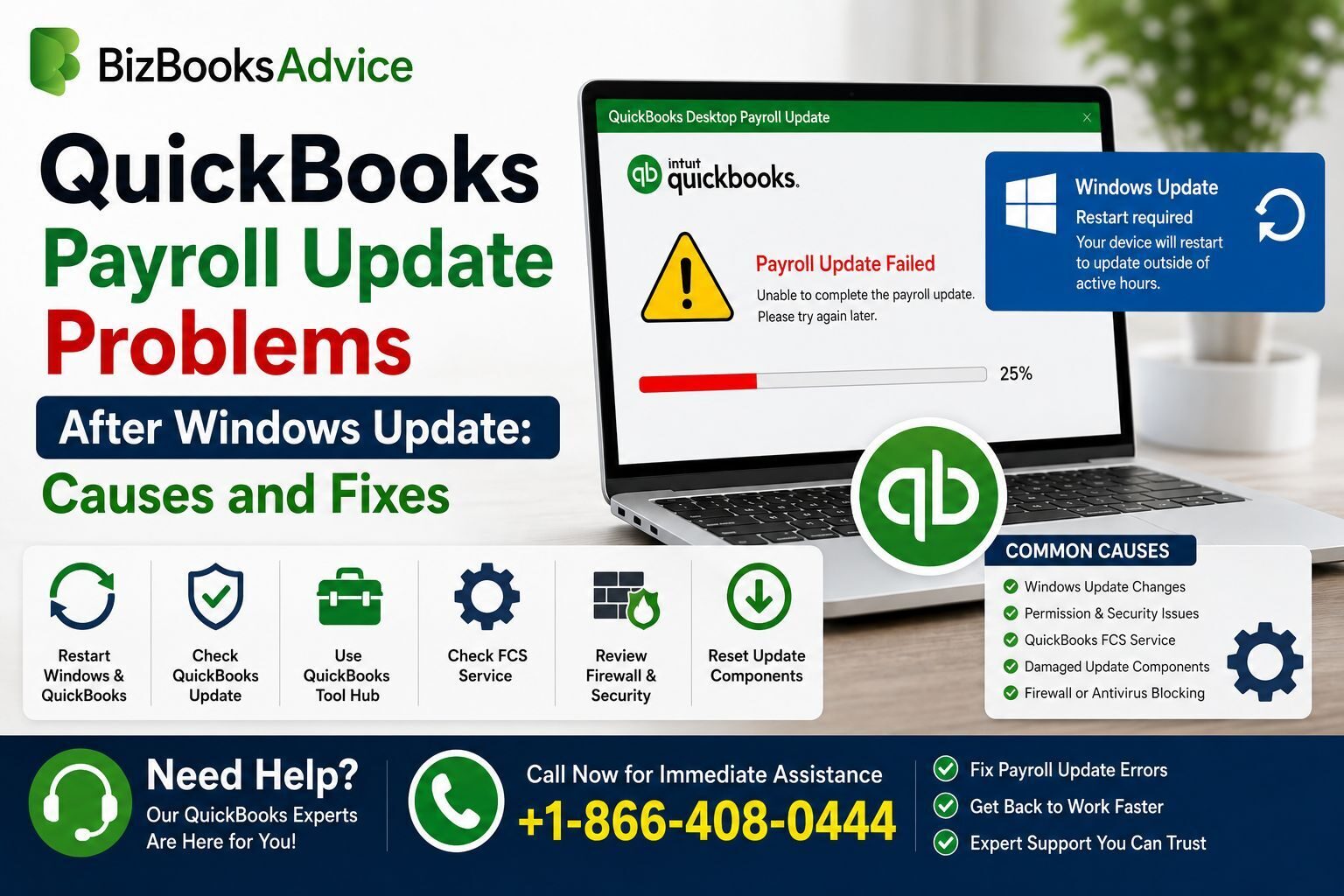
If QuickBooks payroll updates stop working after a Windows update, the problem may be related to changed permissions, security settings, damaged QuickBooks components, an interrupted QuickBooks process, or the QuickBooks File Copy Service (FCS). A Windows update can change system components or security configurations that QuickBooks relies on for downloading and installing payroll updates.
Start by restarting Windows, opening QuickBooks as an administrator, checking your QuickBooks Desktop release, and trying the payroll update again. If that does not work, use QuickBooks Tool Hub, check the FCS service, reset QuickBooks update components, and review firewall or antivirus settings.
If the problem continues, identifying exactly where the payroll update fails is more useful than repeatedly attempting the same update.
Why Do QuickBooks Payroll Updates Stop Working After a Windows Update?
Windows updates are designed to improve security, compatibility, and system performance, but they can sometimes affect applications that depend on Windows services, permissions, network configurations, or security components.
QuickBooks Desktop payroll updates require several components to work together. If one of those components is changed or becomes unavailable after Windows updates, QuickBooks may fail to download or install payroll information.
Common causes include:
- Windows permissions have changed.
- QuickBooks cannot access required folders.
- Firewall or antivirus rules are blocking QuickBooks.
- The QuickBooks File Copy Service is not running correctly.
- QuickBooks update components are damaged.
- A QuickBooks update was interrupted.
- Windows system files have become damaged.
- QuickBooks Desktop needs to be updated.
- The payroll subscription or service key needs attention.
- Internet or security settings are preventing the connection.
This is why a payroll update that worked before a Windows update can suddenly stop working afterward.
Common Signs of a Windows-Related QuickBooks Payroll Update Problem
The symptoms can vary depending on which QuickBooks or Windows component is affected.
You may notice that:
- QuickBooks payroll update will not start.
- Payroll updates stop at a particular percentage.
- The update downloads but fails during installation.
- QuickBooks displays a 15XXX payroll update error.
- QuickBooks freezes while downloading payroll updates.
- QuickBooks closes unexpectedly during the update.
- Payroll tax tables do not appear to update.
- QuickBooks asks you to update repeatedly.
- QuickBooks reports that the update cannot be completed.
- Other QuickBooks features also behave unusually after Windows updates.
If several QuickBooks functions started behaving differently immediately after a Windows update, investigate the Windows and QuickBooks environment rather than focusing only on payroll.
How to Fix QuickBooks Payroll Update Problems After Windows Update
1. Restart Windows and QuickBooks
Start with the simplest solution.
Close QuickBooks Desktop completely and restart the computer.
After Windows loads:
- Open QuickBooks Desktop.
- Open your company file.
- Go to the payroll update section.
- Try downloading the latest payroll update again.
A restart can clear temporary processes left behind after Windows installs an update.
If QuickBooks was running while Windows completed an update, some application components may not have been reinitialized correctly.
2. Run QuickBooks as an Administrator
Windows updates can sometimes affect application permissions.
Try running QuickBooks Desktop with administrator privileges:
- Close QuickBooks.
- Right-click the QuickBooks Desktop icon.
- Select Run as administrator.
- Open your company file.
- Attempt the payroll update again.
If the update works with administrator access, permissions may be involved.
However, don't assume administrator mode is a permanent solution. If QuickBooks consistently requires elevated permissions, investigate the underlying folder, Windows, or security configuration.
3. Check for a QuickBooks Desktop Update
A Windows update can expose compatibility problems with an older QuickBooks Desktop release.
Before troubleshooting further, check whether QuickBooks itself has an available update.
From QuickBooks Desktop, go to:
Help → Update QuickBooks Desktop → Update Now
Select Get Updates and allow the process to complete.
Restart QuickBooks after the update.
Then try:
Employees → Get Payroll Updates
Keeping the QuickBooks program updated can help ensure its components work properly with the current Windows environment.
4. Use QuickBooks Tool Hub
If the problem started immediately after Windows updated, QuickBooks Tool Hub is a useful next troubleshooting step.
The Program Problems section includes Quick Fix my Program, which can close background QuickBooks processes and perform a quick repair.
The general process is:
- Close QuickBooks Desktop.
- Open QuickBooks Tool Hub.
- Select Program Problems.
- Choose Quick Fix my Program.
- Wait for the utility to finish.
- Reopen QuickBooks.
- Try the payroll update again.
This can be particularly useful if QuickBooks processes were left in an unusual state after Windows restarted or installed updates.
For readers experiencing broader QuickBooks payroll update problems, the Tool Hub is only one part of the troubleshooting process. If Quick Fix doesn't resolve the issue, move on to the underlying services and update components.
5. Check the QuickBooks File Copy Service
The QuickBooks File Copy Service (FCS) is an important component to check when troubleshooting certain QuickBooks payroll update errors.
If FCS is disabled, stopped, or not functioning properly, QuickBooks may encounter difficulties while downloading or installing updates.
To check Windows services:
- Close QuickBooks Desktop.
- Press Windows + R.
-
Type
services.msc. - Press Enter.
- Locate the QuickBooks File Copy Service associated with your installation.
- Check its current status.
- Restart the service if appropriate.
- Reopen QuickBooks.
- Try the payroll update again.
If FCS stopped working after Windows updated, this may explain why the payroll update worked previously but fails now.
Don't change unrelated Windows services. If you aren't certain about a service or its configuration, leave it unchanged.
6. Reset QuickBooks Update Components
Sometimes an interrupted update can leave behind damaged or incomplete update components.
Resetting the QuickBooks Desktop update can help establish a clean update attempt.
Open QuickBooks and go to:
Help → Update QuickBooks Desktop → Update Now
Select Reset Update, then select Get Updates.
After the update process finishes, restart QuickBooks and try the payroll update.
If the same error continues, the update components themselves may need additional repair.
7. Check Firewall and Antivirus Settings
Security software is another possible reason QuickBooks payroll updates stop working.
After a Windows update, Microsoft Defender or third-party security software may receive configuration changes. A firewall can then block QuickBooks from accessing resources needed for an update.
Check whether:
- QuickBooks is allowed through the Windows firewall.
- Your security software recently changed its rules.
- QuickBooks executable files are being blocked.
- A recent security update changed application permissions.
Avoid permanently disabling antivirus protection simply to make QuickBooks update.
Instead, identify whether the security software is blocking QuickBooks and configure appropriate exclusions according to the software manufacturer's recommendations.
If you've already checked QuickBooks itself and still cannot complete the payroll update, +1-866-408-0444 can be used to reach the BizBooksAdvice team for guidance on the next troubleshooting step.
8. Check Windows Date and Time
Incorrect Windows date, time, or time-zone settings can occasionally interfere with secure connections and software authentication.
To check:
- Open Windows Settings.
- Go to Time & language.
- Open Date & time.
- Enable automatic time synchronization.
- Confirm the correct time zone.
- Restart QuickBooks.
Then try the payroll update again.
This is a quick check and can eliminate an otherwise easy-to-miss Windows configuration problem.
9. Check Your Payroll Subscription
A program update problem and a payroll subscription problem are not necessarily the same thing.
If QuickBooks opens normally but cannot retrieve payroll updates, check the payroll service information.
In QuickBooks Desktop, look under:
Employees → My Payroll Service → Manage Service Key
Review the payroll service and its status.
If your payroll subscription is inactive or the service information is incorrect, repairing QuickBooks won't necessarily resolve the update problem.
This is especially important when the Windows update and payroll problem happened around the same time but are not actually connected.
10. Repair QuickBooks Desktop
If QuickBooks continues having problems after using Tool Hub and checking the basic settings, the installation itself may need repair.
QuickBooks Tool Hub provides utilities that can help with common installation and program problems.
A repair can be appropriate when:
- QuickBooks crashes during updates.
- Program files appear damaged.
- QuickBooks behaves unusually after an update.
- Multiple QuickBooks features stopped working.
- Payroll updates repeatedly fail despite correct settings.
Restart Windows after completing the repair and test the payroll update again.
If you're unsure whether the problem is caused by Windows or the QuickBooks installation, avoid making multiple system changes at once. Test after each major troubleshooting step so you can identify what actually resolved the problem.
11. Look for a Specific Payroll Error Code
If QuickBooks displays an error code, write it down.
A specific code can provide much more information than the general message that the payroll update failed.
For example, some 15XXX errors can be associated with update components, firewall restrictions, damaged Windows files, the QuickBooks File Copy Service, or digital-signature verification.
Instead of searching for a generic "QuickBooks payroll update failed" solution, use the exact error code to narrow down the cause.
This is also where a targeted troubleshooting guide becomes useful. If you encounter a payroll update error such as Error 15243, follow the troubleshooting steps specific to that error rather than repeatedly reinstalling QuickBooks.
What If QuickBooks Payroll Update Is Still Stuck?
If the payroll update remains stuck after a Windows update, check where the process stops.
Update doesn't start
Focus on:
- Internet connection
- Payroll subscription
- Windows permissions
- Firewall settings
- QuickBooks program health
Update downloads but doesn't install
Focus on:
- FCS
- QuickBooks update components
- Windows permissions
- Damaged QuickBooks files
- Security software
Update freezes at a percentage
Try:
- Restarting Windows
- Running QuickBooks as administrator
- Quick Fix my Program
- Resetting the QuickBooks update
- Checking FCS
- Reviewing security settings
An error code appears
Record the exact code and troubleshoot that error specifically.
This approach is much more efficient than repeating the same update attempt over and over.
Can a Windows Update Cause QuickBooks Error 15243?
A Windows update can potentially contribute to the conditions that produce certain QuickBooks update errors, but it does not automatically mean Windows is the direct cause.
For example, a Windows update could coincide with changes to permissions, security software, system files, or services used by QuickBooks.
If Error 15243 appears after a Windows update, check:
- QuickBooks Desktop release.
- FCS service.
- Update components.
- Firewall settings.
- Windows permissions.
- QuickBooks installation health.
- Payroll subscription status.
If you need help determining whether the Windows update or QuickBooks installation is responsible, you can reach the BizBooksAdvice assistance team at +1-866-408-0444.
How to Prevent Payroll Update Problems After Future Windows Updates
You can't always prevent compatibility problems, but a few habits can reduce the likelihood of interruptions.
Keep QuickBooks Desktop current
Don't leave QuickBooks several releases behind when important updates are available.
Restart after major Windows updates
Allow Windows to finish pending updates and restart completely before opening QuickBooks.
Avoid interrupting payroll updates
Don't shut down the computer while QuickBooks is downloading or installing an update.
Monitor security software
After major Windows or security updates, check whether firewall rules or application permissions have changed.
Keep backups
Maintain recent backups of important QuickBooks company files so you have a recovery option if a serious software problem occurs.
Document error codes
If an error appears, record it before closing the message. That information can make future troubleshooting significantly easier.
Frequently Asked Questions
Why did my QuickBooks payroll update stop working after Windows updated?
A Windows update may have changed permissions, services, security settings, or system components that QuickBooks relies on. The timing doesn't necessarily mean Windows itself is the only cause.
Does QuickBooks Tool Hub fix payroll update problems?
It can resolve some QuickBooks program-related problems. Quick Fix my Program is a useful first step, but it cannot correct every payroll, subscription, firewall, or Windows issue.
Should I reinstall QuickBooks after a Windows update?
Not as your first step. Try restarting Windows, checking QuickBooks updates, using Tool Hub, checking FCS, reviewing security settings, and resetting update components before considering reinstallation.
Why is QuickBooks payroll update stuck at the same percentage?
A recurring freeze can indicate an issue with update components, network access, Windows permissions, security software, or the QuickBooks installation. Note the percentage and any error message before troubleshooting further.
Can Windows Defender block QuickBooks payroll updates?
Security software can potentially block applications or network activity required by QuickBooks. Check firewall and security rules before disabling protection completely.
What should I do if FCS is not running?
Open Windows Services using services.msc, locate the appropriate QuickBooks File Copy Service, and check its status. If the service repeatedly stops or cannot be started, additional QuickBooks repair may be necessary.
Final Thoughts
QuickBooks Payroll Update Problems After Windows Update can be frustrating because the software may have worked correctly before the Windows upgrade. However, the issue is often traceable to a specific component rather than the Windows update itself.
Start with the basics: restart Windows, update QuickBooks, run Quick Fix my Program, check FCS, reset the QuickBooks update, and review firewall or antivirus settings. If those steps don't work, investigate the payroll subscription and QuickBooks installation.
Most importantly, don't repeatedly apply unrelated fixes. Identify where the payroll update fails, then troubleshoot that particular component.
For more detailed information, you can review this guide to fixing QuickBooks update issues and follow the relevant troubleshooting steps for persistent payroll update errors.
If you've gone through the standard checks and still cannot complete the payroll update, +1-866-408-0444 is available for assistance from the BizBooksAdvice team.